How Do Oil and Gas Operators Manage VOC Emissions Compliance in West Virginia?
The moments leading up to production on a new well pad are always high stakes. Drillers have hit their target depths, the fracturing crews have packed up, and the site is moving swiftly into the flowback phase. For energy companies operating across the Marcellus Shale, turning the valve to start production is the ultimate goal. But balancing those aggressive operational timelines with the realities of state environmental law is rarely simple. In West Virginia, pushing a site into active production without the right air quality controls in place can bring operations to a grinding halt.
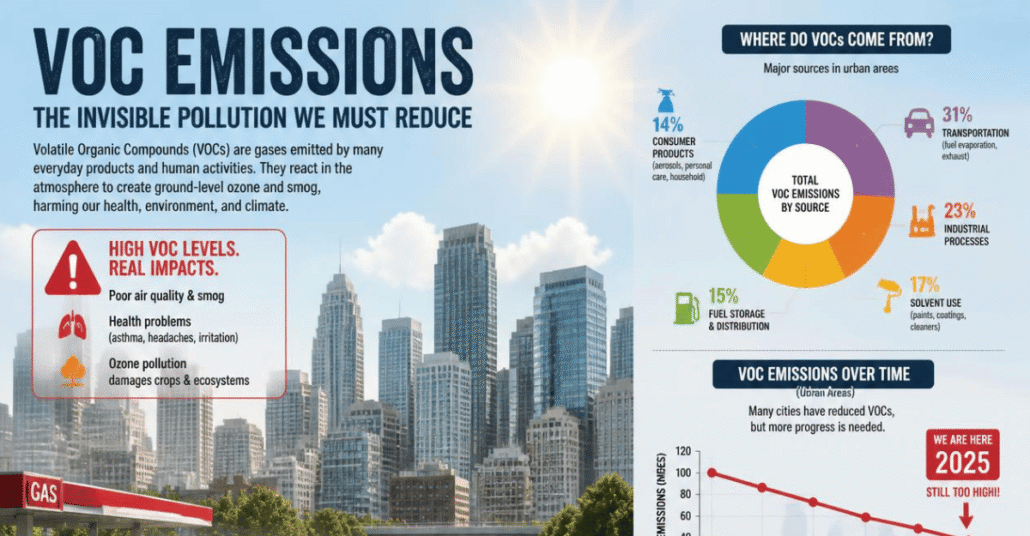
State regulators treat air pollution enforcement with immense seriousness. As hydrocarbons travel from the wellhead through separators, storage tanks, and compressors, volatile organic compounds (VOCs) are inevitably released. Without rigorous containment strategies, those emissions quickly exceed state limits, triggering severe enforcement actions. Energy producers operating from Doddridge County down to the Kanawha Valley face intense scrutiny regarding their facility-wide emissions potential.
What Is the Role of the West Virginia DAQ in Oil and Gas Emissions?
The West Virginia Division of Air Quality (DAQ) enforces state and federal air pollution laws, including the Air Pollution Control Act under WV Code § 22-5. For oil and gas operators, the DAQ strictly regulates volatile organic compound (VOC) emissions through preconstruction permits and ongoing compliance monitoring.
Navigating the regulatory environment in the Appalachian Basin requires understanding exactly who wields enforcement power. The West Virginia Department of Environmental Protection (WVDEP) houses the Division of Air Quality (DAQ), which serves as the primary watchdog for atmospheric emissions. Their mandate is broad, covering everything from massive coal-fired power plants to individual well pads dotting the Ohio River landscape. For the exploration and production (E&P) sector, the DAQ represents the single most important regulatory hurdle before a well can legally produce commercial quantities of gas.
The foundation of their authority rests on the West Virginia Air Pollution Control Act, which grants the agency sweeping powers to inspect sites, demand emissions data, and halt operations that threaten public health or violate statutory thresholds. Whenever an operator plans to construct, modify, or relocate a stationary source of air pollutants, the DAQ is the entity that must review the engineering designs and issue a preconstruction permit.
Unlike some jurisdictions where enforcement is highly centralized, DAQ inspectors are actively present in heavy production areas like Harrison County. They do not merely wait for operators to submit annual reports; they conduct unannounced site visits, audit leak detection records, and utilize optical gas imaging cameras to identify fugitive emissions that are invisible to the naked eye. When operators misunderstand the DAQ’s expectations, they expose their companies to significant financial and operational risks.
When Is a Rule 13 Air Permit Required for a West Virginia Well Pad?
Under 45CSR13, oil and gas operators must obtain an air permit if a facility’s VOC emissions potential exceeds 6 pounds per hour or 144 pounds per day. Permits are also mandatory if a facility triggers substantive requirements of federal emissions control rules like NSPS OOOOa.
The cornerstone of West Virginia’s air quality regulatory framework is 45CSR13, commonly known simply as Rule 13. This rule establishes the threshold for when a facility must undergo formal preconstruction review. It is a strict, mathematics-driven standard that leaves very little room for interpretation. If an operator plans to build a well pad or install new equipment, they must calculate the facility’s Potential to Emit (PTE).
PTE is a critical concept. It is not a measure of what the facility actually emits on an average Tuesday. Rather, it represents the maximum capacity of a stationary source to emit a pollutant under its physical and operational design, assuming it operates 24 hours a day, 365 days a year, without the benefit of unpermitted pollution control equipment. If the calculations push the facility over the legal limits, an air permit is mandatory.
A Rule 13 air permit is triggered if the site meets any of the following emissions conditions:
-
The facility has a potential to emit 6 pounds per hour (lbs/hr) of Volatile Organic Compounds (VOCs).
-
The facility has a potential to emit 144 pounds per day (lbs/day) of VOCs.
-
The site will emit 10 tons per year (TPY) or more of any regulated air pollutant.
-
The operation is subject to substantive requirements of federal emission standards, automatically triggering state permitting obligations.
Operators often make the mistake of looking at individual pieces of equipment in isolation. Rule 13 requires a facility-wide assessment. The VOCs off-gassing from a condensate tank must be added to the emissions from pneumatic controllers, compressor engine blowdowns, and fugitive leaks from flanges and valves. When aggregated, even a moderately sized well pad in the Utica Shale will almost certainly exceed the 6 lbs/hr threshold, making compliance planning a vital early step in site development.
What Is the General Permit G70-D for Well Pad Operations?
General Permit G70-D is a streamlined air quality permit issued by the West Virginia DAQ for eligible oil and gas well pad operations. It covers various modifications at a site but requires operators to submit an Annual Certification and a yearly compliance fee.
Because the oil and gas industry utilizes highly standardized equipment across hundreds of sites, requiring a unique, custom-drafted permit for every single well pad would create massive administrative bottlenecks for both energy companies and the DAQ. To solve this, West Virginia implemented the General Permit system. For E&P operations, General Permit G70-D is the standard regulatory vehicle.
Instead of starting from scratch, operators submit a registration application demonstrating that their proposed facility fits within the operational parameters already analyzed and approved by the state. This drastically reduces the timeline from application to approval. However, operating under G70-D is a privilege that comes with strict, ongoing administrative burdens.
To maintain compliance under G70-D, operators must meticulously track and document specific on-site equipment, including:
-
Natural gas-fired compressor engines and microturbine generators.
-
Storage vessels holding condensate, produced water, or crude oil.
-
Vapor recovery units (VRUs) and enclosed combustion devices used for emissions routing.
-
Pneumatic controllers and pumps that vent gas to the atmosphere.
-
Truck loading operations where vapors can escape during liquid transfers.
Every year, facilities covered by G70-D must submit an Annual Certification. This is not a casual check-the-box exercise. A responsible company official must legally certify that the site remained in compliance with all emission limits, monitoring requirements, and recordkeeping rules over the past 12 months. These documents are submitted digitally through the WVDEP’s Electronic Submission System (ESS). Falsifying or hastily rushing through this certification exposes the signatory to severe legal liabilities.
How Do Storage Tanks Impact VOC Permitting Requirements?
In West Virginia, oil and gas storage tanks are considered permanent emission sources if intended to remain on-site for 180 consecutive days or more. Tanks producing significant condensate often require vapor recovery units and trigger Rule 13 permitting to limit VOC releases.
Storage vessels represent one of the largest sources of potential VOC emissions on any production site. As liquids are separated from the gas stream and pushed into atmospheric tanks, the sudden drop in pressure causes entrained gases to flash off. This “flash gas” is incredibly rich in VOCs. Without intervention, these vapors vent directly out of the thief hatch and into the atmosphere.
West Virginia law draws a hard line based on the duration a tank sits on the pad. If a storage vessel is intended to remain at a location for 180 consecutive days or longer, it is classified as a permanent stationary source. This classification pulls the tank directly into the facility-wide PTE calculations. Because Marcellus condensate is highly volatile, a single unprotected storage tank can easily blow past the 144 lbs/day limit.
To mitigate this, operators must route tank vapors through a closed-vent system to a control device. Most modern sites utilize Vapor Recovery Units (VRUs) to capture the flash gas and push it back into the sales line, turning a liability into a revenue stream. If a VRU is unavailable or impractical, the vapors must be routed to an enclosed combustor or flare capable of destroying at least 95% of the VOCs.
What Are the Rules for Flares, Combustors, and Engines?
Permanent flares and combustors at well pads automatically require an air permit under West Virginia’s 45CSR6. Temporary flares used during flowback for less than 30 days generally do not require a permit. Compressor engines may also require permitting depending on their horsepower and EPA certification.
When VRUs cannot capture all emissions, combustion becomes the primary method of control. However, the act of burning waste gas is heavily regulated under 45CSR6, which governs open burning and particulate matter emissions. Any permanent flare or enclosed combustion device installed on a well pad must be permitted. The DAQ requires operators to prove that these devices are designed properly, equipped with continuous pilot lights, and maintain high destruction efficiency.
There is a vital distinction between permanent production flares and temporary flowback flares. During the initial flowback phase after hydraulic fracturing, large volumes of gas and liquids surge to the surface before permanent infrastructure is fully operational. If a temporary flare is brought on-site solely to handle flowback operations and is removed within 30 days, it typically operates outside the standard Rule 13 permitting requirements, though operators must still track the emissions generated during that window.
Compressor engines are another heavily scrutinized component. The rules differ significantly based on the engine’s horsepower, manufacture date, and whether it is EPA-certified. An uncertified engine driving a compressor requires extensive initial performance testing and ongoing monitoring to ensure its catalytic converter is actually scrubbing the exhaust gases as designed.
How Does Federal NSPS OOOOa Overlap with West Virginia Law?
West Virginia operators must comply with the federal EPA’s New Source Performance Standards (NSPS) Subparts OOOO and OOOOa alongside state laws. These regulations mandate strict leak detection and repair (LDAR) programs and require specific controls for storage vessel VOC emissions.
Energy production does not occur in a state-level vacuum. State air quality rules are heavily intertwined with federal mandates, creating a dual-layer compliance burden. The most critical federal regulations for modern well pads are the New Source Performance Standards (NSPS) Subparts OOOO and OOOOa. These rules target VOC and methane emissions from the oil and gas sector across the entire country.
West Virginia has adopted these federal standards by reference, meaning that a violation of NSPS OOOOa is simultaneously a violation of West Virginia state law. The DAQ is deputized to enforce these federal rules during their standard site inspections. For E&P companies, the most burdensome requirement of OOOOa is the mandatory Leak Detection and Repair (LDAR) program.
Fugitive emissions—small leaks from threaded connections, pressure relief valves, and flanges—account for massive amounts of VOC releases over time. Under the NSPS OOOOa framework, operators must adhere to strict LDAR protocols:
-
Conduct initial optical gas imaging (OGI) surveys within 60 days of startup.
-
Perform semi-annual or quarterly monitoring using specialized infrared cameras.
-
Repair any identified leaks within 30 days of discovery.
-
Maintain highly detailed databases tracking the exact location, discovery date, and repair method for every single leak on the pad.
Failure to maintain accurate LDAR records is one of the most common ways operators trigger enforcement actions. Inspectors do not need to catch a leak in real-time to issue a penalty; simply reviewing a sloppy or incomplete LDAR logbook is enough to substantiate a Notice of Violation.
What Are the Penalties for Non-Compliance with WV Air Quality Rules?
Failing to manage VOC emissions or operating without a required DAQ permit can result in severe consequences for West Virginia operators. Enforcement actions include substantial monetary fines, operational shutdowns, and legal liabilities under the West Virginia Air Pollution Control Act.
The West Virginia DAQ does not issue warnings lightly. When an operator begins construction without a permit, fails to route tank vapors to a control device, or neglects their LDAR surveys, the agency responds forcefully. The typical first step in enforcement is a formal Notice of Violation (NOV). An NOV outlines the specific statutes breached and demands immediate corrective action.
The financial implications of an NOV can be devastating for an operating budget. Under the West Virginia Air Pollution Control Act, the WVDEP possesses the authority to levy civil penalties up to $10,000 per day, per violation. If an operator installed a permanent storage tank without updating their G70-D permit and it operated for six months, the theoretical maximum fines compound rapidly into the millions.
Beyond civil penalties, non-compliance carries severe operational risks. The DAQ has the authority to issue Cease and Desist orders. For an E&P company in Morgantown or Charleston, having a high-producing well shut in by regulators destroys cash flow and damages relationships with investors and midstream partners. Furthermore, chronic environmental violations make it exceedingly difficult for operators to obtain permits for future development projects.
How Pence Law Firm Protects West Virginia Energy Producers
Managing environmental compliance across the Appalachian Basin requires a legal team that understands the engineering realities of a well pad just as well as the statutory language of the Air Pollution Control Act. At Pence Law Firm, our experienced attorneys focus on protecting the operational interests of oil and gas producers across West Virginia. We represent E&P companies in DAQ permit negotiations, enforcement defense, and complex environmental litigation. We know that a Notice of Violation threatens your production timelines and your bottom line.
Contact us today for a confidential consultation to discuss your air quality permitting strategy and enforcement defense options.
Frequently Asked Questions
Can I start building my well pad before my West Virginia air permit is approved?
No. Under Rule 13, you cannot begin actual construction of any stationary source that triggers permitting thresholds until the DAQ issues the final permit. Earth-moving and site preparation may be permissible, but installing foundations for emission sources is strictly prohibited.
How often must I submit a General Permit G70-D Annual Certification?
Operators must submit their Annual Certification once every year, covering the previous 12-month operational period. This certification must be filed electronically through the WVDEP’s Electronic Submission System and signed by a responsible company official.
Are vapor recovery units (VRUs) mandatory in West Virginia?
VRUs are not universally mandatory, but they are often the most effective way to stay under the 144 lbs/day VOC threshold. If an operator chooses not to install a VRU on a high-producing condensate tank, they must utilize another approved control device, such as an enclosed flare, to destroy the vapors.
Does the DAQ regulate temporary flowback emissions?
Yes, although the rules are specialized. Temporary flares used exclusively during the flowback phase for fewer than 30 days generally bypass standard preconstruction permitting. However, the emissions generated must still be tracked and reported under state and federal inventory rules.
What records do oil and gas operators need to keep for LDAR compliance?
Operators must maintain detailed logs of all optical gas imaging surveys, including the date, time, and specific location of any detected leaks. The records must also document the exact date the leak was repaired and the subsequent survey confirming the repair was successful.